Mr. Honda’s advice to follow the flow
The Wind-Up Bird ChronicleMr. Honda’s advice to follow the flow is a rule of action built around a paradox: sometimes the necessary movement is to remain still. He tells Toru Okada that the ordinary world of law and fixed distinctions does not contain the whole of Okada’s nature, then offers ascent, descent, and waiting as responses to changing conditions. His warning about water and his wartime memory give the advice both an uncanny force and a cost: resisting the moment can mean disaster, but recognizing when to wait may be a matter of survival.
The world beyond fixed distinctions
Mr. Honda first frames his advice by telling Okada that legal work may not suit him. Law, he says, presides over “things of this world,” where shadow and light, yin and yang, and one person and another are kept distinct. Okada belongs, in Mr. Honda’s account, to a world above or below that ordinary order. This is not a claim that one realm is better. When Okada asks whether it is better to be above or below, Mr. Honda rejects the ranking: the issue is not superiority, but whether a person is moving in accord with the moment.
The rule takes the form of directions. When it is time to go up, climb the highest tower; when it is time to go down, descend to the bottom of the deepest well. When there is no flow, stay still. Forcing movement against the flow dries everything up, and the dried-out world becomes darkness. The advice therefore does not prescribe passivity or action once and for all. It demands attention to changing conditions, and a willingness to relinquish the self’s insistence on choosing its own direction.
Stillness, water, and the cost of resistance
Kumiko tests the principle directly, asking whether this is one of the times when there is no flow. Mr. Honda confirms that it is: now is the time to do nothing and remain still. His immediate warning is more specific than the general rule. He tells Okada that, sometime in the future, he may undergo real suffering connected with water—water absent from where it belongs or present where it does not—and urges him to be very careful. Asked what kind of water, Mr. Honda cannot identify it; his answer is simply water.
That vagueness makes the warning unsettling without turning it into a precise prediction. Its opposites encompass both deprivation and excess, while its repetition leaves the danger open-ended. The flow principle offers a way to respond, not a way to control what will come: the person must attend to the situation and avoid mistaking forceful action for agency.
Mr. Honda grounds the counsel in a memory of wartime failure. He recalls soldiers who could not reach a river because Soviet tanks, flamethrowers, machine-gun positions, and sharpshooters blocked the way. The men had only Model 38 infantry rifles and twenty-five bullets apiece. Most went to the river anyway; none returned. He draws the lesson plainly: when a person is supposed to stay still, he should stay still. The river is not merely a destination in this recollection. It is water made lethal by the conditions around it, and the attempt to reach it becomes the consequence of ignoring those conditions.
He extends the lesson from that failed advance to the harder discipline of waiting. It can be difficult to wait for the flow to begin, he says, but when waiting is necessary, it must be endured; in the meantime, one should assume oneself dead. Okada probes the severity of the image by asking whether he should remain dead for now, but Mr. Honda does not elaborate. The advice makes suspension sound less like comfortable patience than a temporary surrender of ordinary expectation and self-direction.
The well as a later image of the rule
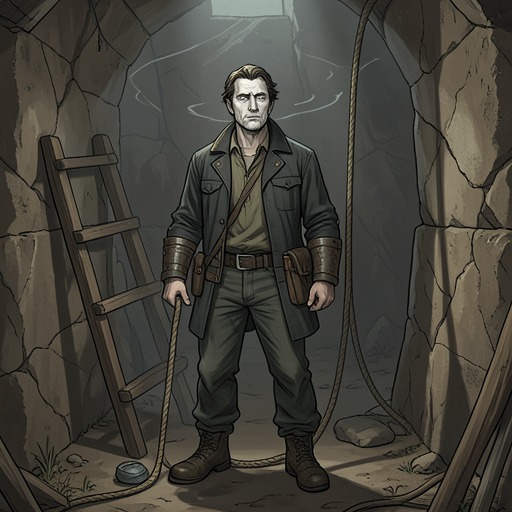
When Okada encounters a dry well, the earlier instructions return to him. He and May Kasahara consider why the hole has not been filled in; Okada supposes that something caused its water to disappear. The absence of water gives Mr. Honda’s warning a physical counterpart, while the well supplies the place for descent that his advice had already named. Okada recognizes that, if he needs one, he now has a well.
He looks down into it in the middle of the day and registers the existence of darkness so deep that daylight does not dispel it. The scene does not explain what the well means or settle what Okada will find there. Instead, the remembered counsel changes how he sees the place: the dry hole is no longer only an abandoned feature of the landscape but a possible route downward, an opening into a darkness that coexists with the visible world. The rule’s lasting force lies in that conjunction of restraint and descent: one must wait when there is no flow, yet be prepared to go down when the moment calls for it.